In this post, we discuss why you can’t feel that muscle working, what this means, and why you should keep training anyway.
At a glance
Feeling a muscle work isn’t a direct measurement of how hard it’s actually working.
Muscles you consciously contract build strong sensory maps; background stabilisers don’t, so they can feel “silent” despite doing real work.
This is a trainable skill: bodybuilders show selective muscle activation on cue, while powerlifters and untrained lifters generally don’t.
An exercise works by loading tissue appropriately, not by being felt — no sensation doesn’t mean no adaptation.
Internal focus cues, touch, and slower tempos can help you feel a muscle working over time.
Introduction
So there you are performing an exercise, watching the weight travel up and down the stack.
Clearly there is work taking place, but if I was to ask you where you feel the effort, and you have no idea, is that a problem?
Some people have genuine trouble locating the muscles that are performing work during resistance training exercises. In particular, those new to resistance training.
That provides us with a clue as to why this is and what we can potentially do about it.
Why you can’t feel some muscles working
It’s tempting to think of muscle sensation like a volume dial — the harder a muscle works, the louder the signal should be.
But what you consciously perceive as a muscle working isn’t a raw broadcast from the tissue itself. It’s a constructed perception, built from several layers: interoceptive and proprioceptive input arriving from the muscle and joint, how much attentional focus is being directed at that specific area, and how well-developed your brain’s sensorimotor map of that muscle is.
Crucially, none of those layers are the same thing as how much force the muscle is producing. A muscle can be contracting appropriately and contributing real mechanical work while the felt sensation of that work lags behind. This is because sensation is a separate, learned perceptual skill, not a direct report of what’s actually happening in the tissue.
Why some muscles are easy to feel and others aren’t
If sensation depends on a developed sensorimotor map, it follows that some muscles will have richer maps than others — and that has very little to do with size or importance, and much to do with how the muscle is used and attended to.
Compare the biceps to the hip adductors, for example. The biceps get flexed, looked at, and consciously contracted in the mirrors of young men all over the land.
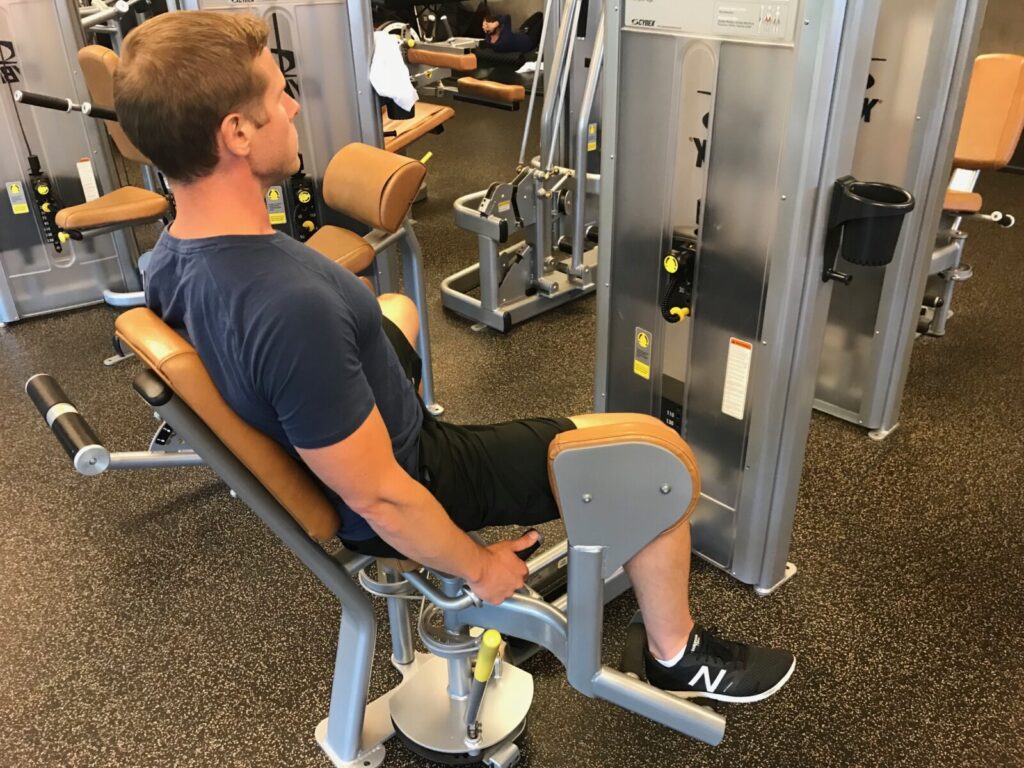
The adductors, by contrast, are almost never consciously activated as a prime mover in daily life. They’re working constantly however, stabilising the hip and pelvis during every step you take, but always in the background, as synergists.
That repeated pairing of consciously activating a muscle, watching it contract, and getting simultaneous sensory feedback is a form of multisensory integration.
This is understood to sharpen the brain’s representation of a body part over time and is well demonstrated in phenomena like the rubber hand illusion, where congruent multisensory input can even reshape perceived ownership of a body part.
Muscles that get this kind of rich, repeated attention, build a higher-resolution map. Muscles that only ever operate in the background — doing real, important work, just rarely consciously watched or directed — don’t.
None of this means the under-mapped muscle is weaker, or not working. It means it’s simply unfamiliar — to the part of your brain responsible for consciously perceiving it.
Training status changes sensation more than people think
Research comparing bodybuilders, powerlifters, Paralympic powerlifters, and untrained individuals during the same lift is revealing here.
Bodybuilders — who spend years deliberately directing tension into a specific target muscle — show clear, selective activation of that muscle when cued to focus on it.
Powerlifters and Paralympic powerlifters, whose training histories are built around producing maximum whole-body force rather than isolating individual muscles, don’t show that same selective response. Unsurprising, neither do untrained individuals.
So being unable to feel a muscle isn’t necessarily a warning sign, and it isn’t unique to beginners — even experienced lifters who’ve built their training around a different goal show a similar response.
Why you should keep training regardless
An exercise doesn’t need to be felt to be effective — it needs to load the tissue appropriately relative to that tissue’s current capacity.
Sensation is a downstream perceptual skill. It’s not the mechanism by which strength is built, and it’s not a prerequisite for an exercise to be effective.
The absence of sensation early on tells you about the current resolution of your body map for that muscle — not about whether adaptation is occurring underneath the surface.
The good news is that this perceptual gap tends to close with persistence. Here are a few things that can speed it up:
- Internal focus cueing — deliberately directing attention to the target muscle, rather than just moving the resistance, measurably increases activation in that muscle.
- Touch — briefly touching the muscle you’re trying to feel gives your attention a physical anchor point, and has been shown to increase activation in the touched muscle specifically.
- Slower tempo and isometric holds — spending longer under tension in a controlled position gives the nervous system more time and more consistent input to build the sensory picture.
Summary
Not feeling a muscle work doesn’t mean it isn’t working. Sensation is a learned, constructed perception — shaped by attention and training history, not a direct readout of mechanical effort.
Under-mapped muscles like the adductors can feel silent even while doing real, effective work. This perceptual gap tends to narrow with practice.