In this post we discuss how to strengthen your toe flexors and why this is important as you age.
In resistance training, there’s a tendency to focus on global strength measures, like how much you can squat, deadlift, or bench press.
Whilst these metrics are fun to chase when you’re younger, as you get older you may find a more isolated approach to be more beneficial.
Nothing illustrates this better than the following study on toe flexor strength in older adults.
Researchers found a lack of big toe flexor strength to be associated with slower walking speed, shorter periods of single-limb support phase, and shorter stride length during fast-pace walking.
Other studies have found toe flexor strength to be associated with balance. This may explain the shorter periods of single-limb support phase in the study above.
Incredibly, the muscle which flexes your big toe, flexor hallucis longus, is estimated to produce forces equivalent to 52% of your body weight.
This is not surprising when you look at its size.

So how do you strengthen your toe flexor muscles?
There are devices available to help you accomplish this. If, however, you want a simple starting point, the following isometric works well.
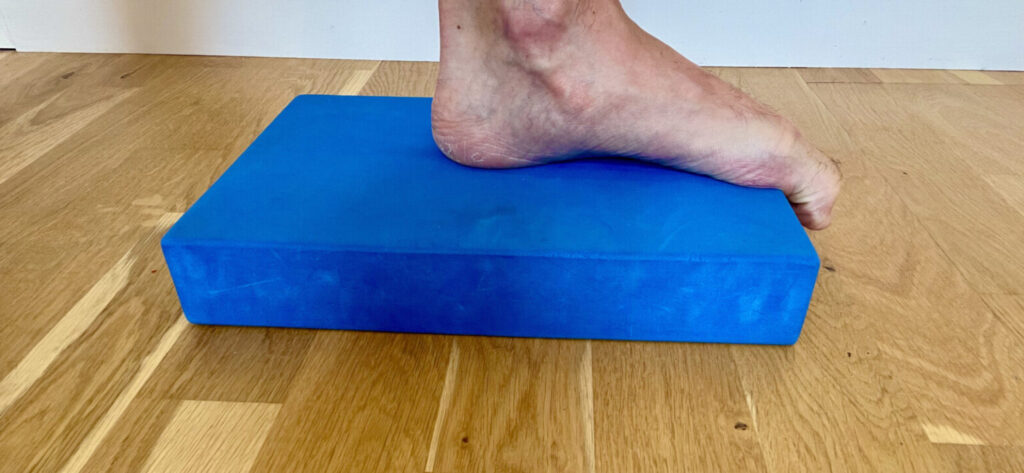
Place your foot on the edge of a yoga block or something similar. Slowly curl your big toe back so the pad of the toe contacts the end of the yoga block.
Gently squeeze your toe back against the block and hold for 10 seconds. Pull back with no more than 30% of your maximum effort. Repeat 6 times.
If you get cramp, or have trouble reaching the block, move your foot back on the block.
Once you can achieve these subtle contractions, increase how hard you push, whilst simultaneously reducing how long you hold them for.
To target the other toe flexors, move the block to a more oblique angle and follow the same timings.
Summary
As we age, smaller muscles like the toe flexors play a crucial role in maintaining balance, walking speed, and stability.
Research shows weak big toe flexors are linked to slower gait and reduced single-leg support during walking.
Strengthening these muscles, particularly the flexor hallucis longus, can improve mobility and reduce the risk of falls.