In this post, we ask if you are compensating around muscle weakness in the gym, using the case of Sarah as an example.
I use this blog to spread ideas that I hope make a difference to people’s lives.
If you’re a regular reader you’ll know these posts usually sit at the intersection of chronic injury and resistance training.
Every so often something happens in a training session that’s worth sharing in the hope of helping you avoid the same situation.
This is one of those.
Meet Sarah – not her real name – a middle-aged lady with intransigent shoulder and neck pain.
She’d had scans and seen multiple practitioners, all trying different approaches, but each doing very little to help.
We got to work.
What muscles are contributing to this situation?
Whilst understanding that the muscular system is an integrated network, I still work on the principle that the local musculature is probably having a considerable effect on the situation.
We start local and work outwards which gives Sarah some initial relief from her symptoms. Excellent.
It’s usually at this point I receive the curve ball. And so it was in this case.
Whilst working around her neck and shoulders I’d been training other areas of her body in a slightly less rigid manner.
It’s nice for clients to experience the fun of training an area of their body without worrying about pain, which resistance training allows for.
I’d been monitoring one of her hips as I’d noticed something on the table that kept flagging up. Her form on the hip exercises we were using was good however, and she was now pushing a fair amount of weight with no obvious compensations.
Nevertheless, a particular range of motion wasn’t changing. I decided to take a closer look.
Muscle compensation can be difficult to spot
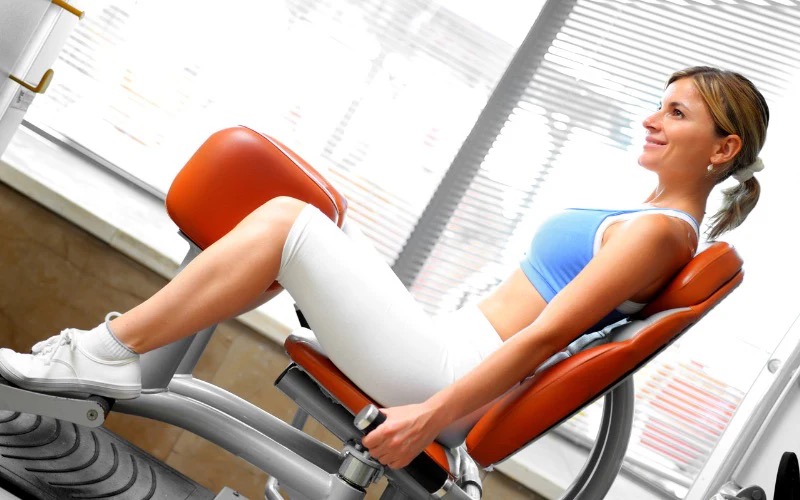
Bear in mind Sarah had been using 70lbs on a hip adduction machine (pushing inwards with both legs) — a fair amount of weight for this exercise.
On closer inspection on the table, however, she could barely offer any resistance to minimal amounts of manual force.
Let me go over that again because it’s crucial to understand for your own training:
70lbs on a single joint hip adduction machine for 15 repetitions with apparent ease.
Zero resistance to me pushing her in the same direction as the machine.
How is this possible?
Well, first of all, this particular machine can only be used bilaterally, meaning you can certainly bias one side. However, this usually comes with telltale signs such as the pelvis shifting or different sensations on each side.
With Sarah there were no signs whatsoever.
We went back to the machine, halved the weight, and slowed everything down to a snail’s pace. Her hip muscles were now visibly shaking on one side.
For 4 weeks she’d been compensating around these muscles. How? I don’t know.
I’ve been doing this job for a long time and it still took me several sessions to notice.
Hats off to Sarah’s nervous system, it certainly had me fooled.
So what does this mean for your own training?
Whilst you might not have someone like me checking your every move, you can still use exercise to explore whether you’re compensating around weakness.
Your first job is to isolate joints as much as possible. If, for example, you’ve been using a squat for a period of time, break that exercise down into its constituent parts.
Once you have a joint motion isolated, reduce both the weight and the speed. Pay particular attention to how the exercise feels when the target muscles are in their short position.
This is where asymmetries will become most obvious. Both in terms of range of motion and the effort required to achieve these positions.
Lastly, just knowing that these situations are possible helps to mitigate against them.
Stay conscious and present whilst you’re training. It can be the difference between achieving progress, or maintaining the status quo.